The Living Computer Revolution: Why Your Next Processor Might Be Made of Cells
Scientists have been building computers inside living cells that can perform Boolean logic, neural networks, and even hash functions – and they might revolutionize medicine

Silicon is Hitting Its Limits
Moore’s Law is dying. Silicon chips are approaching atomic scales where quantum effects make traditional computing unreliable. Heat dissipation is becoming impossible. Energy consumption is skyrocketing.
Meanwhile, in biology labs around the world, scientists are building an entirely different kind of computer – one made of living cells that can think, calculate, and heal simultaneously.
Welcome to the age of biocomputing, where your next medical treatment might involve programmable cells that compute their way to curing cancer.
What is Biocomputing?
Biocomputing flips the entire paradigm of computation. Instead of manipulating electrons through silicon circuits, it manipulates genetic information through biological networks.
The core insight: cells are already computers. They process information, make decisions, and execute programs – we just need to learn how to program them.
Scientists have now demonstrated that engineered cells can perform:
Boolean logic operations (AND, OR, NOT gates)
Neural network computations
Hash functions and cryptographic operations
Memory storage and retrieval
Pattern recognition
The results are mind-bending: living calculators that can simultaneously compute and heal.
The Building Blocks of Biological Computers
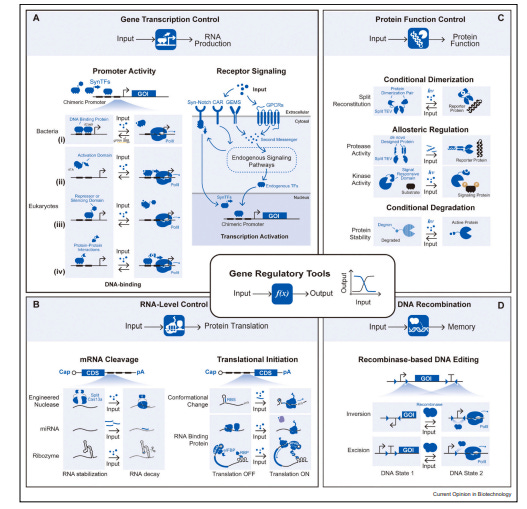
Gene Switches: The Biological Transistors
Just as electronic computers use transistors to control electrical flow, biocomputers use gene switches to control information flow within cells.
Transcription-Level Switches:
Synthetic transcription factors that turn genes ON/OFF based on input signals
Chemical triggers (small molecules, hormones)
Physical stimuli (light, magnetic fields, mechanical forces)
RNA-Level Control:
Engineered nucleases that cut RNA based on specific signals
Ribozymes that fold into structures blocking protein synthesis
RNA-binding proteins that regulate translation
Protein-Level Control:
Split proteases that reconstitute only when triggered
Allosteric proteins that change shape in response to inputs
Protein degradation systems controlled by external signals
DNA Memory Systems:
Recombinases that permanently rearrange DNA to store information
Genetic “hard drives” that remember past inputs
Network Architectures: Single-Layer vs Multi-Layer
Single-Layer Networks: All computation happens simultaneously using orthogonal molecular components. Like having multiple independent processors working in parallel.
Multi-Layer Networks: Information flows through connected layers of gene switches, similar to traditional computer architectures but with biological components.
The Computational Achievements That Stunned Scientists
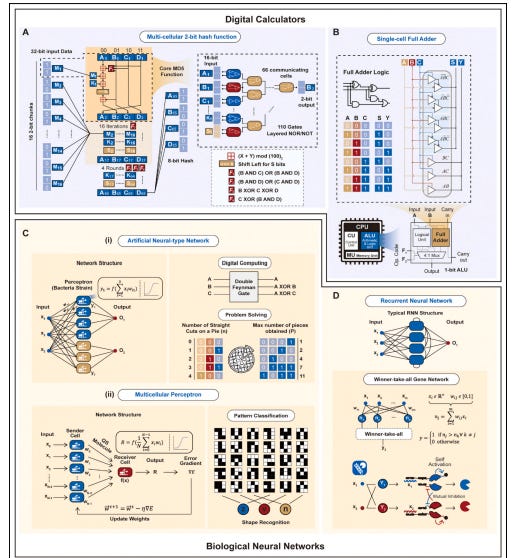
1. Living Boolean Calculators
Scientists built cells that perform digital logic operations with machine precision:
The MD5 Hash Function Implementation:
110 logic gates distributed across 66 E. coli cells
Processes 16 inputs to produce a 2-bit output
Performs the same cryptographic function as electronic computers
But it’s alive and can reproduce itself
Full Adder Circuits:
Single mammalian cells performing arithmetic operations
The fundamental building blocks of computer processors
Using 11 interconnected “tristate buffers” made of gene circuits
2. Neural Networks in Bacterial Colonies
Artificial Neural Networks in Microbes:
Bacterial strains acting as individual neurons
Weighted inputs processed through synthetic transcription factors
Used to solve real problems like prime number identification
Training the network adjusts genetic circuits, not just software parameters
Pattern Recognition Systems:
Multicellular perceptrons trained to classify 3x3 patterns
“Sender” cells detect inputs and produce chemical signals
“Receiver” cells process signals and generate outputs
The network learns by adjusting gene expression patterns
3. Recurrent Neural Networks with Biological Memory
Winner-Take-All Networks:
Mammalian cells implementing competitive neural network behavior
Multiple nodes compete for activation
Self-reinforcing feedback loops strengthen the “winner”
Over time, only the strongest input signal remains active
This mimics brain functions like attention and decision-making, but implemented in living cells.
The Medical Revolution: Therapeutic Biocomputers
The most exciting applications aren’t in replacing silicon computers – they’re in creating treatments that couldn’t exist otherwise.
Smart Cancer Therapy
CAR-T Cells with Logic Gates:
T cells programmed with Boolean logic for cancer targeting
AND gates: Only attack cells with multiple cancer markers
OR gates: Target heterogeneous tumor populations
NOT gates: Avoid healthy tissue with protective markers
Example Logic: Attack cells that are (Cancer Marker A AND Cancer Marker B) AND NOT (Healthy Tissue Marker)
This precision dramatically reduces side effects while improving treatment efficacy.
Programmable Drug Delivery
In Vivo Pharmaceutical Factories:
Cells that sense disease states and produce appropriate drugs
Real-time monitoring of biomarkers
Automatic dosage adjustment based on patient response
Self-regulating therapeutic systems
Diagnostic Biocomputers
Living Biosensors:
Cells programmed to detect specific disease signatures
Amplifying genetic switches that enhance signal detection
Logic gates that integrate multiple biomarkers
Real-time health monitoring from inside the body
The Advantages Biology Has Over Silicon
1. Self-Repair and Evolution
Silicon circuits break down and become obsolete. Biological circuits can heal themselves and evolve to handle new challenges.
2. Molecular-Scale Processing
While silicon struggles to shrink further, biological systems operate efficiently at the molecular level with room for exponential miniaturization.
3. Massively Parallel Architecture
A single cell can run thousands of genetic programs simultaneously. Scale that to billions of cells, and you have computing power that dwarfs supercomputers.
4. Energy Efficiency
Biological systems achieve remarkable computational complexity using minimal energy – far more efficient than any electronic system.
5. Integration with Living Systems
Electronic computers are foreign objects in biological environments. Biocomputers are native to life and can integrate seamlessly with natural biological processes.
Current Limitations and Challenges
Speed vs Precision Trade-offs
Biological information transfer is slower than electronic circuits. While electrons move at light speed, genetic information flow takes minutes to hours.
However, this “slowness” might be a feature, not a bug, for medical applications where precise, sustained responses are more important than speed.
Programming Complexity
Current biocomputing systems require predetermined weight functions and manual optimization. Developing automated “biological compilers” remains a major challenge.
Scalability Questions
While individual demonstrations are impressive, scaling to complex real-world problems requires solving orthogonality issues – ensuring multiple biological components don’t interfere with each other.
The Path to “Cellular Supremacy”
The research identifies key areas where biological computers may eventually outperform electronic ones:
Medical Applications:
Diagnostics that work inside the body
Therapies that compute and adapt in real-time
Personalized medicine based on individual cellular responses
Environmental Monitoring:
Self-sustaining sensors that live in ecosystems
Pollution detection and remediation systems
Climate monitoring integrated with natural systems
Manufacturing:
Self-assembling, self-repairing production systems
Biological factories that adapt to changing requirements
Sustainable production using living systems
The Convergence of AI and Biology
We’re witnessing an unprecedented convergence where artificial intelligence inspires biological systems and biological systems inform artificial intelligence.
Neural networks → Biological neural networks Digital logic gates → Genetic logic circuits Computer memory → DNA storage systems Machine learning → Cellular adaptation
This isn’t just mimicry – it’s the creation of genuinely hybrid intelligence systems that combine the best of both domains.
What This Means for the Future
Near-term (5-10 years):
Advanced CAR-T therapies with sophisticated targeting logic
Implantable biosensors for continuous health monitoring
Cellular drug factories for personalized medicine
Medium-term (10-20 years):
Programmable tissue engineering
Biological computers for environmental remediation
Integration of biocomputing with electronic systems
Long-term (20+ years):
Self-evolving therapeutic systems
Biological intelligence augmentation
Living computers that grow and adapt organically
The Engineering Challenges Ahead
1. Standardization
Biology is messy and context-dependent. Creating standardized biological “parts” that work reliably across different conditions remains challenging.
2. Debugging Biological Code
When genetic circuits malfunction, diagnosing and fixing the problem is far more complex than debugging software.
3. Containment and Safety
Programmable living systems require robust containment strategies to prevent unintended environmental release.
4. Regulatory Frameworks
Current regulatory structures aren’t designed for living computers that evolve and adapt.
Investment and Market Implications
The biocomputing market is attracting significant investment:
Synthetic biology companies raising billions
Pharmaceutical giants investing in cellular programming
Defense applications for biological sensing
Agricultural applications for smart crops
Early movers in this space may gain insurmountable advantages as the technology matures.
The Philosophical Implications
Biocomputing challenges fundamental assumptions about the nature of computation, intelligence, and life itself.
If cells can be programmed to think and compute, what distinguishes biological intelligence from artificial intelligence? Are we creating a new form of life or simply repurposing existing life?
These aren’t just technical questions – they’re philosophical challenges that will reshape how we understand consciousness, intelligence, and the nature of life itself.
Your Role in the Living Computer Revolution
This technology will transform medicine, computing, and potentially every aspect of human life. Understanding biocomputing now positions you to:
Recognize investment opportunities in synthetic biology
Understand the future of personalized medicine
Participate in discussions about the ethical implications
Prepare for a world where the line between living systems and computers disappears
The Bottom Line
We’re witnessing the birth of a new form of intelligence – one that’s simultaneously artificial and natural, programmed and evolved, computational and biological.
Silicon computers gave us the information age. Biological computers may give us something far more profound: the merger of technology and life itself.
The question isn’t whether this revolution will happen – it’s already underway in labs around the world. The question is whether you’ll be prepared for a world where your medicine thinks, your sensors evolve, and your computers are alive.
The age of living computers has begun. The cells are already computing – we’re just learning to program them.
What aspect of biocomputing intrigues you most? The medical applications, the philosophical implications, or the technical challenges? This technology will reshape multiple industries – which ones do you think will be transformed first?