Inside Anthropic's Engineering Blog: The Blueprint for Production AI Systems
While everyone chases the latest model releases, Anthropic's engineering team is quietly publishing the playbook for building AI systems that actually work in production

Anthropic’s engineering blog isn’t getting the attention it deserves. While the AI world obsesses over benchmark scores and parameter counts, their engineering team is documenting the hard-won lessons from building reliable AI systems at scale. This isn’t marketing content or research papers. This is operational knowledge from teams running some of the most sophisticated AI systems in production.
For Gen AI engineers building real systems, this blog represents something rare: practical guidance from practitioners who’ve solved the problems you’re about to encounter. The collection spans from low-level implementation details to high-level architectural decisions, all grounded in production experience rather than theoretical possibilities.
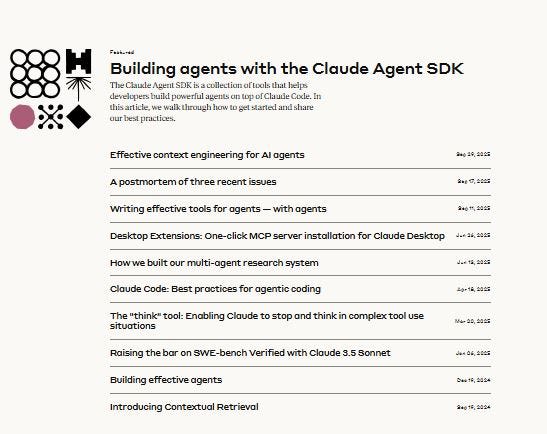
Desktop Extensions: Making AI Tools Actually Usable
The most recent post tackles a problem every AI engineer faces: tool installation friction. Desktop Extensions make installing Model Context Protocol servers as easy as clicking a button, but the technical architecture behind this simplicity reveals sophisticated engineering decisions about user experience, security, and system integration.
The insight here extends beyond Claude Desktop. Any AI system requiring external tool integration faces the same challenge: how do you make powerful capabilities accessible without overwhelming users with configuration complexity? The post shares technical architecture decisions and patterns for creating extensions that balance ease of use with security and reliability.
Multi-Agent Research Systems: When One Agent Isn’t Enough
Their April post on building multi-agent research systems addresses a fundamental limitation of single-agent architectures. When tasks require deep exploration across multiple domains, coordinating specialized agents outperforms trying to make one agent handle everything. The architecture patterns they share apply broadly to any complex research or analysis workflow.
The key insight: separation of concerns matters in AI systems just as much as in traditional software. Specialized agents with focused capabilities, coordinated by an orchestration layer, consistently outperform monolithic approaches for complex tasks. This matches what we’re seeing across production AI deployments, where hybrid architectures combining multiple specialized models outperform single-model solutions.
Claude Code: Agentic Coding Best Practices
The March post on agentic coding best practices deserves special attention from anyone building code generation systems. Claude Code represents Anthropic’s production-grade approach to autonomous coding, and the best practices they share come from extensive testing and iteration. The patterns they identify for effective code generation, error recovery, and context management apply whether you’re building with Claude or any other LLM.
What makes this particularly valuable is the focus on reliability over capability. The post emphasizes strategies for making code generation systems robust and predictable rather than chasing impressive but unreliable behavior. This production-focused mindset separates systems that work from demos that impress but fail under real-world conditions.
The Think Tool: Stopping to Think Matters
The January post introducing the think tool addresses a subtle but critical aspect of AI agent behavior. In complex tool use situations, rushing to action often leads to suboptimal outcomes. The think tool enables Claude to pause and reason before committing to tool invocations, dramatically improving decision quality in multi-step workflows.
This reflects a broader principle: effective AI systems need mechanisms for deliberation, not just action. The architecture patterns for implementing think-before-acting behavior apply across different agent frameworks and problems. The technical implementation details they share about balancing computational cost against decision quality provide practical guidance for similar trade-offs in other systems.
SWE-bench Verified: Raising the Bar on Code Understanding
Their December post on improving performance on SWE-bench Verified demonstrates what happens when engineering teams focus on systematic improvement rather than one-off optimizations. The progression from earlier Claude versions to Claude 3.5 Sonnet shows steady gains from architectural improvements, better training strategies, and refined evaluation methods.
What’s notable here is the methodology. Rather than claiming victory from cherry-picked examples, they focus on verified benchmarks with reproducible results. The engineering approach they describe for identifying failure modes, developing targeted improvements, and measuring progress provides a template for systematic capability improvement in any AI system.
Building Effective Agents: The Foundation
The September post on building effective agents established many of the principles that underpin their subsequent work. The distinction between workflows and agents, the importance of tool design, and strategies for maintaining reliability across long-running tasks form the conceptual foundation for practical agent development.
This post is essential reading because it establishes vocabulary and mental models for thinking about agent systems. The framework they provide for understanding agent capabilities, limitations, and appropriate use cases helps avoid common pitfalls where teams either over-rely on agents for deterministic tasks or under-utilize them for problems requiring adaptive reasoning.
What Makes This Blog Different
Most AI company blogs oscillate between marketing hype and impenetrable research papers. Anthropic’s engineering blog occupies the valuable middle ground: technical depth without academic obscurity, practical guidance without oversimplification. The posts assume reader intelligence and engineering competence while remaining accessible to practitioners who haven’t spent years in AI research.
The consistent themes across posts reveal their engineering philosophy. Reliability matters more than capability. Systematic improvement beats heroic optimization. Clear abstractions and separation of concerns apply to AI systems just as they do to traditional software. User experience shouldn’t be sacrificed for technical sophistication. These principles guide their engineering decisions and show through in every post.
The Production Mindset
What distinguishes these posts from typical AI content is the production mindset. Every technique, architecture decision, and best practice comes from building systems that need to work reliably under real-world conditions. This isn’t about what’s theoretically possible or what works in controlled demos. This is about what survives contact with actual users, edge cases, and production constraints.
For Gen AI engineers, this mindset matters more than specific implementation details. The questions they ask about each system component, the trade-offs they consider, and the evaluation criteria they apply provide a mental framework for production AI development. Learning to think like a production AI engineer requires seeing these patterns across multiple systems and problem domains.
Applying These Lessons
The blog posts collectively form a curriculum for building production AI systems. Start with the fundamentals from “Building Effective Agents” to establish mental models and vocabulary. Move through specific implementations like Claude Code and multi-agent research to see principles applied to concrete problems. Study the systematic improvement process from SWE-bench work to understand how to make progress on hard problems.
The architectural patterns recur across posts. Context management strategies appear in multiple contexts. Tool design principles apply whether building code generation systems or research agents. The think-before-acting pattern from the think tool generalizes to many decision-making scenarios. Recognizing these patterns helps apply lessons from one domain to problems in another.
The Missing Pieces
While the blog provides exceptional technical depth, some critical production concerns receive less attention. Cost optimization strategies, monitoring and observability patterns, failure mode analysis, and production debugging techniques get mentioned but deserve fuller treatment. Security considerations for agent systems, particularly around tool access and data handling, could use more explicit coverage.
These gaps likely reflect ongoing work rather than oversight. As Anthropic’s systems mature and patterns become clearer, expect future posts addressing these operational concerns. The engineering blog seems to document lessons as they solidify rather than speculating about best practices still under development.
Strategic Implications for AI Engineering
The blog’s existence signals something important about the state of AI development. We’ve moved past the era where model capabilities alone determined outcomes. System engineering, architecture decisions, and operational practices now differentiate successful AI deployments from failures. Anthropic’s willingness to share engineering insights publicly suggests they believe competitive advantage comes from execution rather than keeping techniques secret.
For engineering teams, this creates both opportunity and responsibility. The knowledge for building production AI systems exists and is increasingly accessible. The challenge shifts from figuring out what’s possible to executing well on known patterns. This democratization of AI engineering knowledge accelerates the field while raising the bar for what constitutes good work.
The Future of AI Engineering Content
Anthropic’s engineering blog sets a standard other companies should follow. Practitioners need this middle ground between marketing hype and academic research. The AI field matures faster when companies share hard-won lessons about what works in production. The blog demonstrates that sharing engineering knowledge builds credibility and advances the field without compromising competitive position.
As AI systems become more complex and production deployments more common, this style of content becomes essential. Teams building AI systems need engineering guidance, not just model benchmarks. Architecture patterns, reliability strategies, and production best practices matter more than incremental capability improvements for most applications.
Your Next Steps
The blog posts build on each other, so reading them in sequence provides maximum value. Start with “Building Effective Agents” to establish foundations, then follow the chronological progression to see how thinking evolves. Pay special attention to recurring themes and patterns that appear across multiple posts. These represent robust principles rather than context-specific solutions.
As you read, consider how patterns apply to your systems. The specific tools and models differ, but architectural decisions and engineering principles generalize. The questions they ask about system design, the trade-offs they consider, and the evaluation methods they employ provide templates for your own development process.
The engineering blog represents something rare: senior engineers at a leading AI company documenting what actually works. For practitioners building production AI systems, this knowledge is invaluable. The insights come from extensive experience, systematic thinking, and a willingness to share hard-won lessons.
What’s your biggest challenge in building production AI systems? Which aspect of Anthropic’s engineering approach resonates most with your work?
Explore the full engineering blog: https://www.anthropic.com/engineering
Super cool augmentation for the good 😊
Best practices for the good 😊